


How to Bring a Service Dog on Disney Cruise Line

Disney Cruise Line (DCL), like most cruise lines, allows service dogs and provides quite a few services for them. But as with any cruise ship, you will have quite a few hoops to jump through before your dog is allowed on board. On the upside, Disney offers some surprising perks, along with DCL-specific tips to make the experience as good as possible.
DCL is a premium cruise line, which means it’s relatively expensive but also offers stellar service and experiences. In addition to typical cruise experiences such as fine dining, unique adult-only venues, lovely swimming pools, and state-of-the-art theaters, Disney also offers its trademark experiences, such as character meet-and-greets and unique events such as Halloween on the Seas and Very Merrytime Christmas cruises. This means Disney cruises are very much family cruises, though the ship has adult-only areas.
In this article:
- Pros and cons of choosing a Disney cruise with your service dog
- Planning for a DCL cruise with your service dog
- Navigating a DCL ship with a service dog
- Tips for DCL cruising with a service dog
Pros and cons of choosing a Disney cruise with your service dog
There are very real pros and cons to taking a service dog on a Disney cruise (as opposed to another cruise line). That’s because Disney offers a unique experience that differs significantly from, say, a Celebrity cruise.
Pros of taking your service dog on a Disney cruise
- Disney is actively supportive of service dogs and provides a very nice relief station with a pretend “hydrant” in a quiet area of the ship.
- Characters are often willing to engage with service dogs in character. Pluto, for example, is a Disney “dog” who plays with service dogs when they come up to meet him.
- Many Disney cruises include fully accessible visits to the company’s private islands. It’s easy for DCL staff to help you customize your experiences at Castaway Cay and Lookout Cay, both in the Caribbean and included in many cruises.
- Because it is so family-friendly, DCL generally downplays drinking and offers almost no gambling. This makes the on-board experience a bit quieter and more predictable.
Cons of taking your service dog on a Disney cruise
- As a family-friendly cruise line, Disney is full of children who can’t wait to pet and play with service dogs. It can be tricky to fend off would-be playmates without hurting anyone’s feelings.
- Some events are so child-friendly that they can be a bit chaotic. If your dog is not familiar with young children, they may find these activities hard to navigate.
- Service dogs are not permitted in the pools, saunas, or wet play areas on board DCL ships and may not be left unattended inside a stateroom. Disney Cruise Line Crew Members are not permitted to take control of a service dog. These rules are typical of any cruise line.
Planning for a DCL cruise with your service dog
Cruising with a service dog takes a lot of up-front planning, so it’s best to start early. According to DCL: “You are responsible for obtaining the import permits from all countries that require those special documents and must have those original documents available at all times. Specific information may be obtained by contacting the United States Department of Agriculture, or the applicable United States consulate, or embassy of each country to determine such country’s policies and obtain the permits needed for each port of call on the sailing itinerary. Please be aware that obtaining those permits can take weeks or months, and some countries may not allow dogs to enter at all.” In addition to permits, some countries may require specific health documentation and vaccinations.
To ensure a positive experience, DCL recommends filling out their Special Services Information Form as soon as possible to access assistance with any special arrangements. Guests must notify DCL that they intend to bring along a service dog at least 30 days before their sail date. You’ll also want to read through their disability guide and make use of all the resources they offer both for service dog users and for all disabled cruisers.
Remember, cruise ships typically don’t carry dog food or any of your dog’s supplies except the pellets used in their relief areas. That means you’ll need to pack along everything from leashes and vests to food, toys, plastic bags, and food bowls.
Navigating a DCL ship with a service dog
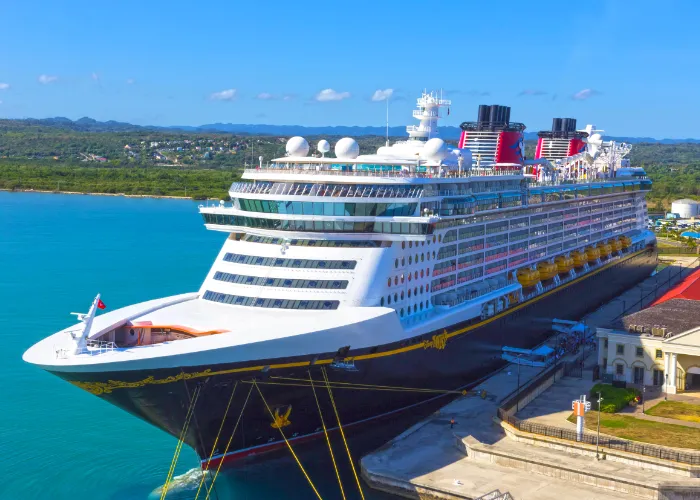
Every DCL ship is a bit different; you can find ship maps on the DCL website. In general, there are four “classes” of ships, from the smaller Magic Class ships (Magic, Wonder) that are specifically designed to look like the old Cunard Line to the very large Global Class ships, which will include the Adventure setting sail in 2026. All areas of DCL ships are open to service dogs except the pools and other wet locations, but of course some areas are quieter than others.
All DCL ships include:
- Kids’ clubs that are exclusive to children in specific age groups;
- Adult-only areas that are quieter and less themed, where adults can find their own pools, cafes, and spa areas;
- Disney-themed lounges and bars that become adult-only at night;
- Themed rotational dining rooms;
- Family pools;
- Family and adult entertainment;
- Specialty fine dining options.
- Some DCL ships also offer lazy river rides, water-park style rides, and other entertainment amenities.
Every DCL ship offers a relief station called Pluto’s Corner, and the station is always located on Deck 5 Forward, port side. You can learn more about Pluto’s Corner and how to find it by watching this video made by a service dog user aboard a DCL vessel.
Tips for DCL cruising with a service dog
There are several simple ways to make your DCL cruising experience more pleasant for you and your dog. Here are some of the top tips:
- If you can, choose a verandah room and request a verandah potty for your dog. DCL will set it up for you, so you won’t have to traverse the entire ship every time your dog needs to go.
- If you are not in a verandah room, ask DCL for the exact location of the relief station on your ship and select a room with easy access.
- Be aware that the high-end restaurants on the ship are smaller and quieter than the main restaurants. If you and your dog want a night away from the crowds, they are good options.
- Check your “Navigator” (daily schedule) so you know when and whether there will be very loud, crowded events. In particular, Pirate Night in the Caribbean can be tough on dogs as it includes fireworks. You might also want to avoid the main lobby during “dance” events, as these can create a bit of a sensory overload. If you’re looking for great photo ops, the main lobby with its grand staircase and giant portholes is perfect, but only at “off” hours.
- Avoid the family pools during at-sea days, as they will be jammed and very loud. If possible, enjoy the relative quiet of the adult areas or check out the lounges and clubs, many of which are open but uncrowded during the day.
- If your dog is likely to find crowds difficult, be sure to arrive at venues as early as is feasible. For example, arrive at theaters early to choose an appropriate spot. The main theaters are very large, but every seat is a good one; you may prefer to stick with a balcony seat near the back for a quicker exit.
- If you’re traveling without children, choose the second seating for dinners. This will reduce the number of tired toddlers, which means less noise and fewer kids wanting to pet your dog.
- Have a plan for managing your dog if you are going to a pool or other “wet” location, since staff can’t care for your dog and you can’t leave it alone in a stateroom.
- Dress your dog in official “service dog” gear at all times, and have a plan for handling curious and friendly children.
About the Author: Lisa Jo Rudy, M.Div. has been writing on developmental disabilities and mental health since the early 2000s, when her son was diagnosed with autism. Lisa lives on Cape Cod, where she is the proud "mom" of two beautiful cats.
Related Articles

Service Dog Rules for Staying in Hotels
Service dogs have hotel rights as part of the public access rights given to service dogs and their handlers under the Americans with Disabilities Act (ADA). This means they cannot be treated as pets and can accompany their handlers at no additional cost. Unfortunately, hotel staff members are sometimes unaware of these rights and don’t […]

Read More

International Travel Service Dog Regulations
Service Dog Regulations & Traveling Internationally Are you planning a trip with your Service Dog to another part of the world? Before you show up at the airport, or even before you book your flight, there are some important regulations and rules you will need to know when traveling with a Service Dog. Service Dog […]
Read More

Guide for Traveling with a Service Dog in Europe
Traveling is exciting. Taking in new sites, discovering interesting people, and making memories are all things a wonderful vacation should be. These expectations shouldn’t change because you need to travel with a service dog. However, before you book your flight, there are some things you will need to keep in mind when traveling to Europe […]
Read More