


Atlanta International Airport Dog Travel Guide

If you’re flying out of Atlanta with a dog, congratulations: you’ve chosen a most dog-friendly airport, according to Chewy! Not only are there dog relief stations in every concourse, but there’s also an outdoor dog park featuring biodegradable bags and benches. Of course, while amenities are wonderful, flying with a dog can still be stressful.
In this article:
- Plan ahead for success
- Arriving at the airport
- Parking at ATL
- Animal relief stations
- Checking in for your flight
- Going through security with your dog
- Spending time at ATL with your dog
- Boarding with your dog
Plan Ahead for Success
There are regulations related to flying with animals, and pitfalls you can experience at the airport if you aren’t prepared. Here are a few planning tips to reduce stress.
Know Your Dog and Plan for Success
Check with your airline to be sure your dog is not too big to fly in the cabin, and to get all the information you need about where and how your dog will travel. If your dog is energetic, plan ahead to provide plenty of exercise. If your dog is anxious, plan to travel at an “off” time.
Have Your Crate and Airport Transportation Plans Ready
Unless your dog is an official service animal, it should be crated inside the airport except in pet relief areas, where it should be leashed. That means you’ll need to plan ahead as you move through the airport with a heavy crate rather than simply walking your dog through the concourse.
Be Prepared with Paperwork
If you’re flying into or out of the United States, you will almost certainly need vaccination and health certifications. Requirements vary in every country, so do your homework and complete exams and paperwork ahead of time. You may also need specific documents and forms to share with American TSA agents or airline officials.
Know How You’re Getting There and Back
Pets are typically allowed in airport shuttles, so if you are parking off-site or in the economy lot, that’s fine. But it’s still smart to arrive early, try to fly at “off” hours, and have a plan in mind. You may even want to consider a service like Wag America, which provides specialized pet transportation and much more.
Arriving At the Airport
If you arrive at the airport at the wrong time, or come without a plan, you could be in for a wait (or a rush). For many dogs, that can be stressful. To avoid rushing or waiting in long lines, follow these tips:
Choose Flight Times With Crowds in Mind
Every day and every hour is different, but often follows a pattern. According to the Hartsfield-Jackson Airport’s website, “The busiest times usually occur between 5 a.m. and 9 a.m., as well as days before and after holidays and long weekends.”
Know How You’ll Get to the Airport Terminal
An airport as big as ATL has options for you to get to the airport terminal you need. For example, if you’re using a rental car, you’ll take the Skytrain to the terminal. If you’re coming from a hotel, you’ll grab a shuttle. If you’re traveling between concourses, you’ll ride the terminal-to-terminal shuttle.
Consider TSA PreCheck
A TSA PreCheck allows you to move quickly through security. There are now quite a few options available, including Global Entry and CLEAR.

Parking at ATL
In addition to off-site park-and-ride options, ATL offers a wide range of on-site parking. The following rates are accurate as of March, 2026.
Hourly (Short-term) Parking: The North and South Hourly Parking Lots, which are the closest to each terminal entrance, are ideal for picking up or dropping off individuals at the Airport.
- $10/hour
- $50 Maximum for the first day
- $75 Maximum each additional day
- Lost Ticket Fee = Maximum Daily Rate Plus Duration of Stay
Daily Parking (Covered Deck): This 4-level overnight parking area is directly across from each terminal.
- $30/day (flat rate)
- Lost Ticket Fee = Maximum Daily Rate Plus Duration of Stay
Economy Parking: The North is next to the parking decks.
- $20/day (flat rate)
- Lost Ticket Fee = Maximum Daily Rate Plus Duration of Stay
Domestic Park Ride:
- $15/day (flat rate)
- Lost Ticket Fee = Maximum Daily Rate Plus Duration of Stay
ATL West Parking: Located at 4199 Skytrain Way, College Park, GA 30337.
- $10/hour
- $30/day
- Lost Ticket Fee = Maximum Daily Rate Plus Duration of Stay
ATL Select: Located at 1800 Sullivan Rd. College Park, GA 30337.
- Uncovered: $15/day (flat rate)
- Covered: $20/day (flat rate)
- Oversized Vehicles: $40/day (flat rate)
- Lost Ticket Fee = Maximum Daily Rate Plus Duration of Stay
International Hourly: The International Hourly lot — just steps from check-in and arrivals — contains more than 1,100 parking spaces. The International Hourly parking deck features 14 close-in parking spaces for alternative fuel vehicles and 14 parking spaces for vanpools and carpools. From Maynard H. Jackson Jr. Boulevard, follow the signs to hourly parking.
- $10/hour (first hour)
- $15/hour (2nd – 5th hour)
- $70 Maximum for the first day
- $100 Maximum each additional day
- Lost Ticket Fee = Maximum Daily Rate Plus Duration of Stay
International Park Ride (Covered Deck): The International Park Ride facility on Maynard H. Jackson, Jr Boulevard, just west of Loop Road, offers 2,400 parking spaces. Passengers will take a three-minute ride on a shuttle bus to the international terminal’s Departures level and pick you up at the Arrivals level upon your return. The free shuttle is available 24 hours a day.
- $30/day (flat rate)
- Lost Ticket Fee = Maximum Daily Rate Plus Duration of Stay
Animal Relief Stations
It’s always a good idea to let your dog get in a little exercise before a flight. ATL is right on top of that with its unique pre-security locations for exercise and relief.
Outdoor Pre-security Options
- North Terminal: On the lower level, outside door LN2 to the right of the building. You’ll find Poochie Park, the largest airport dog amenity in the country, at 1,000 square feet. Poochie Park is a fully fenced outdoor dog park with benches for pet owners and biodegradable waste bags.
- South Terminal: In the Ground Transportation area outside doors W1 and W2. You’ll find a grassy area where dogs are welcome (so long as you clean up after them).
- Domestic Terminal South: A 1,000-square-foot dog park is located pre-security in the Ground Transportation area.
Indoor Options
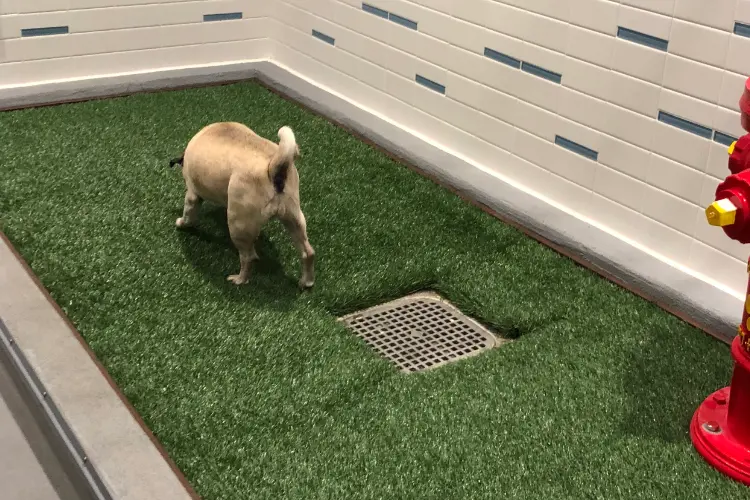
It’s important to know that, because the Atlanta airport is often under construction, relief stations do shift about a bit. As a result, while there are always pet relief stations in every concourse, and there is generally signage to point the way, the locations may change from time to time. Indoor stations generally include artificial turf or pet-friendly flooring, a small “fire hydrant” for dogs, waste bags and trash receptacles, and a sink or cleaning station nearby.
Here are the current locations of dog relief stations at ATL:
- Concourse A & B: Indoors along a side hallway off the main gate area. Signs above head or on the wall point toward “Service Animal Relief Area.” Follow arrows just as you would for restrooms.
- Concourse C & D: Similar setup, usually down a short corridor near restrooms, nursing rooms, or family restrooms.
- Concourse E (international flights): Indoor area near central amenities or restrooms, useful for pets arriving or departing on international routes.
- Concourse F (International Terminal): This concourse may offer both indoor and nearby outdoor relief options. Passengers using the Maynard H. Jackson Jr. International Terminal (Concourse F) frequently find this convenient for long-haul flights.
- Concourse T is closest to the Domestic Terminal and can often be reached without using the Plane Train if you’re near the main atrium.
Checking In for Your Flight
Checking in with a dog can be complex, especially if you’re flying into or out of a country other than the United States.
When You’re Traveling Abroad
If you’re flying into ATL, you’ll need to check on federal regulations for bringing an animal into the United States. For example, your dog must be at least six months old, and must be properly vaccinated. Then you’ll need to certify that your dog has not been in a high-risk country for dog rabies for at least six months. The CDC’s dog importation Navigator will help you determine what you need and how to certify your dog’s wellness for the journey.
And, if you’re flying from the US to another country, you’ll need to investigate and comply with that country’s rules and regulations. Each nation has slightly different rules, so it’s important to do your research and complete all forms and health checks before arriving at the airport. For example, dogs flying to the UK need pre-approval letters from the Animal Reception Center in your destination city.
Reviewing Your Airline’s Requirements
Each airline has slightly different regulations and requirements related to flying with a dog. Check with your carrier ahead of time to be ready with any paperwork, so you’re not surprised at the last minute.
Remember that dogs on airplanes must fit under your feet or in your lap. That typically means about 15-20 pounds. Larger dogs fly as manifest “baggage” in a pressurized, temperature-controlled compartment. It’s also important to note that emotional support dogs do not get special treatment but instead are considered to be pets.
Going Through Security with Your Dog
The good news is that dogs can typically walk through security with you, on a leash. Your dog’s carrier can just go through the scanner. TSA works with dogs every day, and no special documentation is required during security screenings. Of course, you will be subject to ordinary screenings just like everyone else.
The slightly less good news is that security lines can be long, and dogs can get anxious when required to stand and sit for long periods of time among strangers. In addition to choosing less crowded times and springing for the cost of a precheck pass, you might also want to allow your dog to run and relieve itself right before you join the line.
Security at ATL
While standard security is almost always available, Priority, CLEAR, and PreCheck have more limited hours at Atlanta International Airport. You can check on wait times in advance by visiting the ATL website: https://www.atl.com/times/. These are the hours during which different types of security screenings are available, as posted on their website:
| Location | Screening Categories | Hours of Operation |
| Domestic Terminal Main | Standard Screening | 24 Hours |
| Domestic Terminal North | Standard ScreeningPriority Screening | 4:00 a.m. to 9:00 p.m. |
| Domestic Terminal Lower North | Standard ScreeningCLEAR Standard | 3:30 a.m. to 9:00 p.m. |
| Domestic Terminal South | TSA PreCheckPreCheck Touchless IDCLEAR w/ PreCheck | 4:00 a.m. to 9:00 p.m. |
| International Terminal Departures | Standard ScreeningTSA PreCheck | 4:30 a.m. to 12:00 a.m.7:00 a.m. to 10:00 a.m, 2:00 p.m. to 7:00 p.m. |
Spending Time at ATL with Your Dog
If you have time to kill at ATL with your dog, you’re in luck. Not only are there relief stations throughout the building, but there are also options for walking, entertaining, and feeding your dog at the airport.
Dog Snacks
In addition to all its other dog-friendly amenities, Atlanta International is home to a shop called Good Boy Goodies, a Georgia-owned, all-natural dog-treat vendor. They offer premium treats like Honey-Glazed Sweet Paw-Tato and Blueberry Peanut Butter, along with pet toys. Even better, Good Boy Goodies can be found in three locations across the airport: T10 Express (Concourse T), ATL Shops (Concourse F), and CNN (Concourse F, Pre-Security).
Water Stations
You really can’t ask for a better water and relief setup than the one offered at Atlanta International. Here’s how they describe their setup:
Each Service Animal Relief Area is spaciously equipped with pet supplies and concrete and grassy turf areas, as well as a ground-level drinking fountain. All equipment is ADA accessible, including an automated entry door. Pet cleanup is simple with biodegradable pet waste bags and an overhead shower hose. The floor surface is antimicrobial, seamless, and it is stain and slip-resistant. A single sink is stationed on an adjacent wall for travelers to freshen up before leaving the space.
Boarding with Your Dog
Remember that your dog, if it is allowed to fly in the cabin with you, will not be allowed out of its crate. That means no exercise or relief options for the duration of the flight, so be prepared. Have your dog use the nearest relief station as close to boarding as possible, but avoid giving your dog food or water right before to avoid accidents.
While there is no guarantee, many airlines will allow pet owners to board early. Ask at your flight counter, and arrive as early as is feasible.
Once on board, your dog will need to remain under your feet or on your lap. It will also need to remain calm. You and your dog may be asked to disembark as a result of barking or growling.

About the Author: Lisa Jo Rudy, M.Div. has been writing on developmental disabilities and mental health since the early 2000s, when her son was diagnosed with autism. Lisa lives on Cape Cod, where she is the proud "mom" of two beautiful cats.
Related Articles
Flying With a Service Dog – The Ultimate Guide
This article was last updated to reflect the latest updates in the DOT’s rules for air travel. This is a guide to everything you need to know to travel with your service dog or psychiatric service dog. You’ve seen a dog in the airport and you’ve always wondered, “how they can fly with their dog?”. […]

Read More

Can You Still Fly with a Miniature Horse on an Airplane
The term “service animal” can cause uncertainty among anyone not familiar with its legal definition. This can result in conflict when it comes to expectations and accommodations in public or with airline travel. As currently stipulated by the Americans with Disabilities Act (ADA), a service animal is defined as a dog specifically trained to perform […]
Read More
How to Fly with a Service Dog on United Airlines
United Airlines offers customers the most comprehensive network of worldwide routes. They also include one-stop or no-stop flights to and from anywhere in the United States. With hubs inside the four largest U.S. cities, it’s no wonder that United Airlines leads the airline industry. If you’re planning on booking a flight, United Airlines is probably […]
Read More