


Can You Bring a Service Dog to a Music Concert?
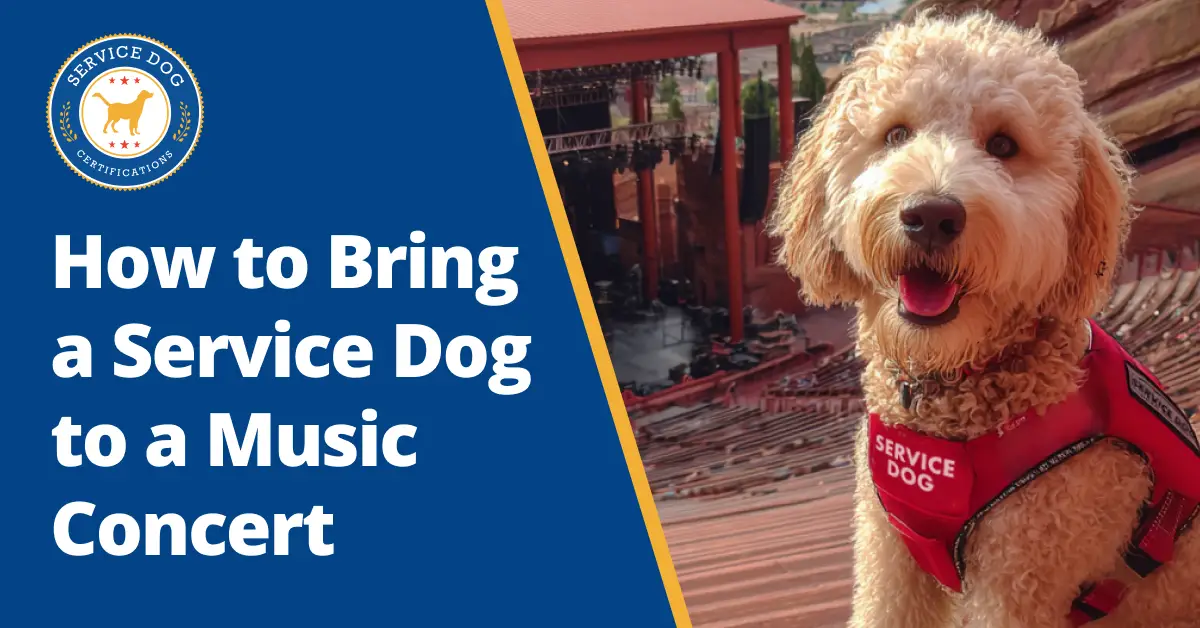
Yes, you can bring your service dog to a concert, but you’ll want to take special precautions. Under the Americans with Disabilities Act (ADA), trained service dogs are allowed anywhere the public may go, including your favorite artist’s shows. Venue staff can verify your service dog only by asking two questions:
- Is the dog a service animal required because of a disability?
- What work or task has the dog been trained to perform?
When you arrive at a concert, an usher or security guard may stop you briefly to confirm that your dog is a service animal. The exchange should be short and limited to the two ADA questions. Some venues will direct you to an accessibility check-in desk for additional support or to log your seat number in case you need re-entry later. Under the ADA, they can’t ask about your disability, require paperwork, or ask the dog to demonstrate its task.
Concerts can be a tricky place to bring any animal because of sound levels that shake the floor, bright lights that flash without warning, and packed crowds that leave little space for movement. In this guide, we’ll share some tips for having a great night at a show with your service dog.
In this article:
- Why service dog gear is a must at concerts
- Practical advice for concert venues
- Concert venues with service dog policies
Why Service Dog Gear is a Must at Concerts
Sound at a concert can reach 100 decibels or more, which is loud enough to make simple conversation difficult. In that environment, visual indicators become essential. A vest clearly labeled “SERVICE DOG”, an identification card, or a bright leash tag that reads “DO NOT PET” conveys what your voice may not be heard to explain.
Inside the venue, lighting and noise create additional headaches. A reflective or high-contrast vest helps staff and nearby fans recognize that your dog is working. It prevents curious strangers from reaching out during the show and reassures others that the animal is permitted.
The purpose of the gear isn’t to prove legitimacy but to communicate. When words are drowned out by sound, one visible word, “SERVICE”, can prevent confusion, save time, and protect your dog’s concentration.
Practical Advice for Concert Venues
- Choose appropriate seating
Avoid general-admission pits or standing-room areas with no clear floor space. Accessible or reserved seating will give your dog room to settle safely. - Arrive early
Entering before the crowd fills in allows your dog to adjust and gives you time to locate exits, rest areas, and guest services. - Plan for the sound
Concerts can exceed 100 dB. Dogs hear at higher frequencies and can find the vibrations disorienting. Sit farther from speaker stacks and avoid direct exposure to subwoofers. Consider short breaks outside if your dog shows signs of stress. - Watch the footing
Outdoor venues may have grass, gravel, or cables underfoot; indoor arenas often have sticky or wet floors. Booties can help protect paws. - Schedule relief breaks
Ask at the accessibility desk which gate allows re-entry for service-dog relief. Step out during slower moments between sets rather than during crowd surges. - Expect crowd movement
During key moments (an encore, a light show, or a surprise guest), the crowd may surge forward. Keep your dog tucked in a “settle” position until the rush passes. - Have a backup exit plan
Identify two routes out of the building. If your dog becomes overstimulated, venue staff can help you move through a side aisle or elevator corridor.

Concert Venues with Service Dog Policies
Red Rocks Amphitheatre (Morrison, Colorado)
Policy: Service animals are permitted. Emotional support, therapy, or comfort animals are not recognized as service animals under ADA guidelines. Each service animal must remain with its handler and be properly restrained.
Contact: Visit their contact page for guest service and FAQ.
United Center (Chicago, Illinois)
Policy: Only trained service animals and service animals in training for guests with disabilities are allowed inside the arena.
Contact: Their Contact Us page lists ADA ticketing contact information.
Madison Square Garden (New York City)
Policy: Only service animals are permitted; emotional support and comfort animals are not. Animals must be leashed or harnessed at all times.
Contact: Visit their Accessibility Services page for more information.
Hollywood Bowl (Los Angeles, California)
Policy: Service animals are welcome; animals must be housebroken and under control. The venue is not responsible for supervising or cleaning up after any animal.
Contact: Their Accessibility Information page contains specific contacts.

About the Author: The writing team at Service Dog Certifications is made up of folks who really know their stuff when it comes to disability laws and assistance animals. Many of our writers and editors have service dogs themselves and share insights from their own experiences. All of us have a passion for disability rights and animals.
Related Articles
Uber’s Service Animal Policy
Uber is working to make catching a ride easier, safer, and always a five-star experience. They connect the rider with affordable transportation anytime, anywhere, all at a tap of a button. You can also see your driver’s contact information and the vehicle’s details in the app, so you will always know you’re getting into the […]

Read More
Can I Take My Service Dog into the Movie Theater?
Under the Americans with Disabilities Act (ADA), service dogs must be allowed to accompany their handlers anywhere the general public is allowed to go, including movie theaters. According to the ADA “Service animals are defined as dogs that are individually trained to do work or perform tasks for people with disabilities.” Service dogs perform specific […]
Read More
Can a Service Dog be Taken to School?
A disability doesn’t end at the doors of a school. For the most part, a school may be where a child or young adult learns to navigate the world with their disability. Because service dogs are part of how a person manages their disability, a service dog must be involved in a child or young […]
Read More