


Labrador Retriever: Breed Overview


The Labrador Retriever is one of the most popular dog breeds in the world, and for good reason. Known for their intelligence, loyalty, friendly nature, and willingness to work alongside people, Labradors have become one of the most common breeds chosen for service dog roles.
Originally bred as working retrievers, Labradors have a long history of helping humans. Today, they assist people with a wide range of disabilities, including mobility challenges, visual impairments, medical conditions, and psychiatric needs. Their combination of trainability, steady temperament, and desire to please makes them highly suited to the demanding role of a service dog.
In this article:
- Temperament and personality
- Size and weight
- Lifespan and health issues
- Grooming and shedding
- Training and intelligence
- Pros and cons of ownership
- Best environment
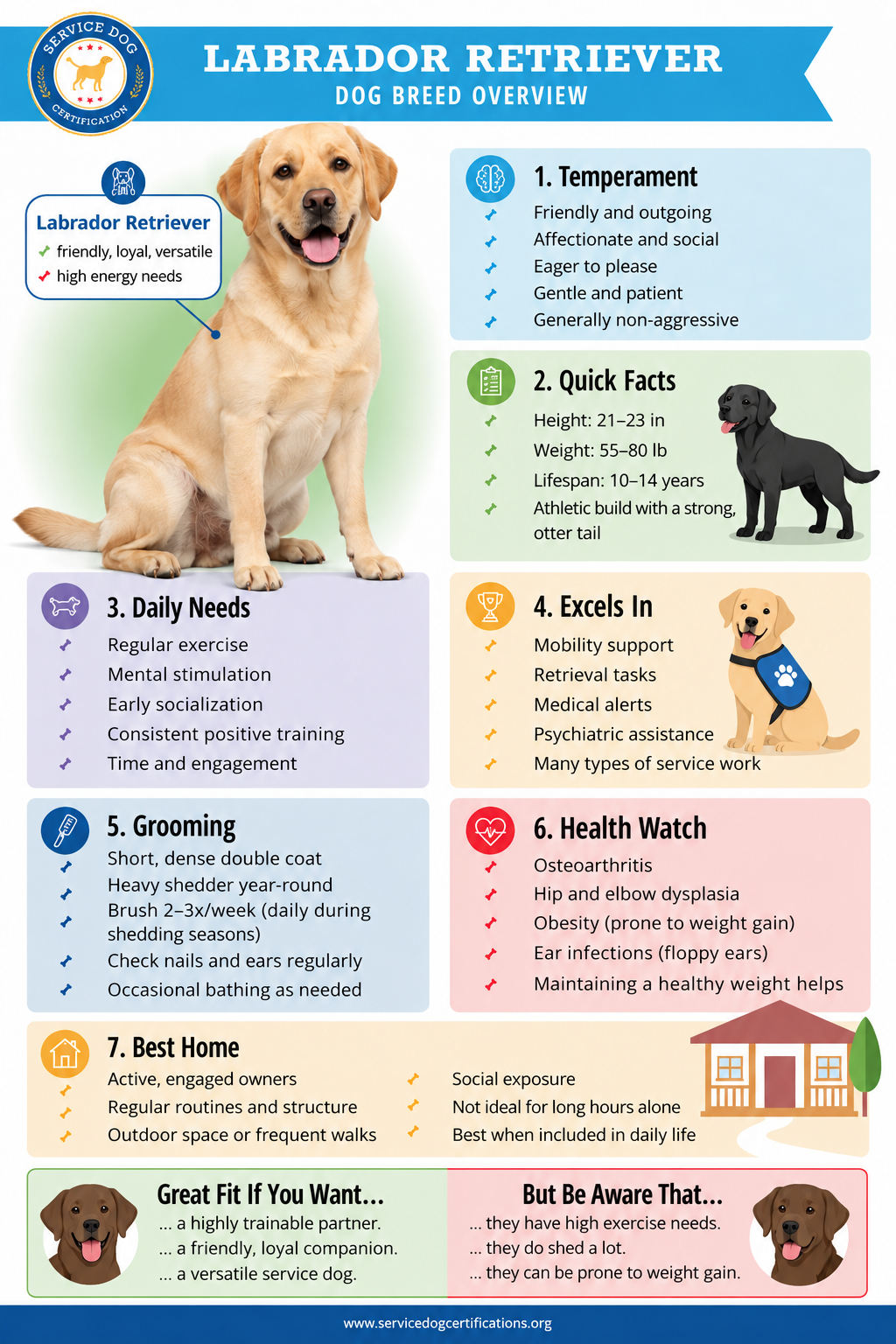
Share this image on your site
Temperament and Personality
Labrador Retrievers are known for their friendly, outgoing, and people-oriented temperament. They are generally confident dogs that enjoy human interaction and tend to form strong bonds with their handlers. They can be excellent with children, although their size and exuberance mean they require close supervision.
Key personality traits include:
- Affectionate and social
- Eager to please
- Gentle and patient
- Highly food-motivated
- Generally non-aggressive
For service work, their friendly demeanor and willingness to engage make them highly suitable. However, young Labradors can be highly energetic, boisterous and playful, so maturity and consistent training are essential before they can reliably work in public settings. A service Labrador must also demonstrate good impulse control, the ability to ignore distractions, and the calmness to settle quietly when not working.
Size and Weight
Labradors are medium-to-large dogs with a strong, athletic build and a characteristic “otter” tail that helped them work effectively in water.
Typically, their height varies from 21–23 inches (54–58 cm) and their weight from 55–80 lbs (25–36 kg). Males are generally slightly taller and more heavily set than females.
Their size is often ideal for service work because they are large enough to perform mobility-related tasks, but still manageable in public environments such as transport, shops, and offices.
Lifespan and Health Issues
The average lifespan of a Labrador Retriever is around 10 -14 years, according to data from over 33,000 Labradors in the UK.
Like many popular breeds, they can be prone to certain hereditary and lifestyle-related health issues. The most common disorders recorded in Labrador Retrievers are:
- Degenerative joint disorders such as osteoarthritis
- Developmental joint problems, such as hip and elbow dysplasia
- Obesity
- Ear infections (due to floppy ears)
Labrador Retrievers are well known for their love of food, and some lack a gene that regulates food intake and satiety, so that obesity can be a real problem in the breed. Maintaining a healthy weight is especially important for service dogs, as excess weight can reduce working ability and shorten working life.
Grooming and Shedding
Labradors have a short, dense double coat that is relatively easy to maintain but sheds heavily year-round.
The routine grooming needs of Labrador Retrievers include a thorough brushing 2–3 times weekly (possibly increasing to daily during shedding seasons), regular ear and nail checks, and occasional bathing as needed. Avoid over-bathing, as it is usually unnecessary and may disrupt the skin’s natural environment.
Training and Intelligence
Labradors are highly intelligent and widely regarded as one of the most trainable breeds, similar to a German Shepherd. They respond well to positive reinforcement, especially food-based rewards.
Their key training strengths include their reputation as quick learners, strong food motivation that supports effective reward-based training, excellent problem-solving abilities, and a strong focus and bond with their handler when properly trained.
For service work, they typically undergo task-specific training such as mobility support, alerts, and retrieval tasks, along with advanced public access training and basic obedience commands such as sit, stay, and recall.
While intelligent, they can be easily distracted in adolescence, so consistent structure is essential, and they respond best to a calm and consistent training schedule. Labradors’ intelligence and motivation to be active also lend themselves to boredom and accompanying destructive behaviors, with sufficient mental and physical stimulation required. Their natural exuberance can also lead to unwanted behaviors such as jumping up and pulling on the leash.
It is recommended that training start early, focus heavily on positive reward-based training, and include mental enrichment such as puzzle tasks as well as physical commands.

Pros and Cons of Ownership
Labrador Retrievers can be delightful and rewarding companions, but their reputation as ‘easy to train’ can be misleading. These loyal companions require an active time commitment to become calm, confident companions.
Pros
- Highly trainable and intelligent
- Friendly and stable temperament
- Strong human focus and loyalty
- Versatile for many types of service work
- Adaptable to different environments
Cons
- High shedding
- Prone to weight gain
- High food motivation can lead to distraction
- Require regular exercise and mental stimulation
- Can be overly excitable and exuberant, especially when young
Best Environment
Labradors adapt well to a wide range of environments, but they thrive best in structured, active households where they can participate in daily life and form strong bonds with their families and handlers.
Ideal environments include homes with regular daily routines, excellent access to outdoor exercise space or frequent walks, ongoing social exposure, and handlers who can provide consistent training reinforcement.
They may struggle in environments where they are left alone for long periods or not given enough physical and mental stimulation. For service roles, they perform best when integrated closely into the handler’s daily life.
The Labrador Retriever remains a top choice for service dog work because of its intelligence, stable temperament, and willingness to work closely with humans. With proper training, socialization, and care, they can provide reliable, long-term assistance across a wide range of service roles.
About the Author: Dr. Lizzie Youens, BSc (Hons), BVSc, MRCVS, is a veterinarian with academic training in Veterinary Science, Veterinary Medicine, and Animal Behavour & Welfare. She brings more than a decade of experience across diverse veterinary settings, including rural branch practices and large hospital environments. Lizzie resides in the Forest of Dean with her family and two rescue cats.
Related Articles

Benefits of a Raw Food Diet for Dogs
Diet is a very important part of keeping your dog healthy. There have been many articles about dog food made in China that had harmful ingredients. A raw food diet is the most natural and healthiest way to feed your favorite canine. Here are a few arguments about feeding your dog a raw food diet. […]

Read More

Fourth of July Pet Safety: What Can My Dog or Cat Eat?
Your dog is probably going to beg for food at your Fourth of July party. Your cat might try to sneak a taste of something when nobody’s looking. Most of the time, a little bite won’t hurt them, but sometimes it will. Veterinarians have seen too many pets end up sick because someone didn’t know […]
Read More

How to Keep Your Dog Safe on Halloween
Imagine Halloween through the eyes of a curious dog: baffling sights, peculiar smells, and an array of sounds, from the joyful squeals of costumed children to the persistent ringing of doorbells. It’s a time of excitement and potential stress that warrants special attention from dog owners. Here, we explore how to make Halloween a joyful, […]
Read More