


Which US Airlines Accept Pets as Cargo or Baggage?
If you want to fly with your dog, and it’s a smaller dog like a Yorkie or Chihuahua, you’re in luck. Most airlines will allow small dogs and service dogs to fly with you so long as they are crated appropriately and can fit under your feet. But if you have a larger dog, your options are much more limited unless your dog is a service animal or you are a member of the military.
In this article:
- Dog size matters when flying
- Why cargo travel can be hard on dogs
- Why airlines became stricter about pet cargo
Dog Size Matters When Flying
No domestic US airlines currently allow large pet dogs in the cabin, and no domestic US airlines will allow non-military dog owners to check their dogs as baggage so they can fly on the same flight as their owner. Only one airline makes an exception: Alaska Air. And while Alaska Air does fly some larger pets as baggage, many restrictions and rules apply. This leaves few options for Americans with large dogs who want to send their pets by air: they can fly as cargo (not baggage), on a semi-private flight, a shared charter, or a private jet.
To send your dog as cargo, you must work through an airline’s cargo service. American Airlines, for example, has a service called Pet Embark. The service includes transportation as needed, food and water, and relief breaks, all of which your pet will need if they are delayed or their flight is canceled. Programs like Pet Embark are available only on certain types of planes and flights and do not operate in locations where the weather is extremely hot or cold. You can calculate the cost of cargo travel on the website; for a larger dog in a crate, it will cost hundreds of dollars.
The data table below explains exactly which dogs can travel in the cabin and which can’t, and provides detailed information about the size of the animal and crate allowed by each carrier.
↔ Scroll sideways to see every column
| Airline | Cargo | In Cabin | In Cabin Fee | Exact Wording | Notes / Limits | Official Link |
|---|---|---|---|---|---|---|
| Delta | No | Small pet only w/ fee | $150 | “Until further notice, we are only allowing the shipment of pets for active U.S. Military or U.S. State Department Foreign Service Offices (FSO) traveling with active permanent change of station orders.” | Pet must remain in carrier the entire trip; max carrier size 18″ L x 11″ W x 11″ H | delta.com ↗ |
| Alaska Airlines | Yes | Small pet only w/ fee | $100 | — | Many restrictions and caveats to help care for the animal in cargo w/ min and max connection times and care stops; for in cabin, pet must remain in carrier the entire trip; max carrier size 17″ L x 11″ W x 9.5″ H | alaskacargo.com ↗ |
| American Airlines | Yes | Small pet only w/ fee | $150 | “If your pet is too large to fly in the cabin, it must travel with American Airlines Cargo. Keep in mind, we only accept checked pets for active-duty U.S. Military and U.S. State Department Foreign Service personnel traveling on official orders,…” | Pet must remain in carrier the entire trip; max carrier size 18″ L x 11″ W x 11″ H | aa.com ↗ |
| United | No | Small pet only w/ fee | $150 | “We no longer let you check your pets through the PetSafe program. Pets can only fly in cargo when traveling with certain active-duty military or State Department employees.” | Pet must remain in carrier the entire trip; max carrier size 17.5″ L x 12″ W x 9″ H | united.com ↗ |
| Southwest | No | Small pet only w/ fee | $125 | — | Pet must remain in carrier the entire trip; max carrier size 18″ L x 13.5″ W x 9.5″ H | southwest.com ↗ |
| Frontier | No | Small pet only w/ fee | $99 | “…we do not transport pets in the cargo hold.” | Pet must remain in carrier the entire trip; max carrier size 18″ L x 14″ W x 8″ H | flyfrontier.com ↗ |
| Hawaiian Air | Yes | Small pet only w/ fee | $100 | — | Many restrictions and caveats to help care for the animal in cargo; for in cabin, pet must remain in carrier the entire trip; max carrier size 17″ L x 11″ W x 9.5″ H | alaskacargo.com ↗ |
| Allegiant | No | Small pet only w/ fee | $50 | “Allegiant does not transport animals in the cargo…” | Pet must remain in carrier the entire trip; max carrier size 17″ L x 11″ W x 10.5″ H | allegiantair.com ↗ |
| JetBlue | No | Small pet only w/ fee | $150 | “Only small dogs and cats may travel in the cabin…” | Pet must remain in carrier the entire trip; max carrier size 17″ L x 12.5″ W x 8.5″ H | jetblue.com ↗ |
Why Cargo Travel Can Be Hard on Dogs
If you’re a dog-lover, you know that most dogs are intelligent, emotional animals. Traveling by cargo, which means traveling in a crate handled by strangers in a strange location with new sounds and smells, is a big challenge for most dogs. In theory, cargo travel companies work their hardest to provide your pet with a low-stress experience. But cargo flights can still be difficult, despite everyone’s best efforts. You can address some of the most common problems, however, by taking some steps ahead of time and thinking through your options.
- Dogs may be anxious when separated from their owner and handled by strangers.
If your dog has become overly attached to you, it’s a good idea to start leaving it with known, trusted friends for a few hours from time to time. Over weeks or months, this helps your dog acclimate to spending time with new people in new places. - Long crate time can be physically and emotionally stressful.
If your dog is accustomed to sleeping in a crate, the experience may be less anxiety-producing. But if your dog has never spent time in a crate, they shouldn’t start with a long air trip in a cargo hold. To make life easier for your dog, work with your cargo carrier to ensure a direct flight that takes as little time as possible. You may also want to restrict food and drink before the trip, since your dog won’t have a chance to relieve itself during the flight. - Weather and temperature restrictions can cancel or delay travel.
In many cases, you or a trusted person will have to pick up your dog at the arrival gate as soon as it arrives. If your plane is delayed, your dog may wind up stranded. - Breed, age, and health risks matter.
Just as an older adult with health issues should probably avoid roller coasters, so a dog with mental or physical health issues should probably avoid air travel. Extreme anxiety or physical pain can make an ordinary plane trip into an ordeal. Certain breeds, too, may be in more physical danger in a cargo hold. For example, short-nosed breeds are not allowed aboard Alaska Air flights; these include Boston Terrier, Boxer (all breeds), Bulldog (all breeds), Bull Terrier, Bussels Griffon, Chow Chow, English Toy Spaniel, Japanese Spaniel/Japanese Chin, Mastiff (all breeds), Pekingese, Pit Bull (all breeds), Pug (all breeds), Shih Tzu, Staffordshire Terrier. - Cargo is not always the best option.
If you’re a civilian traveling with a large pet dog and want your dog to travel at a lower price, cargo is really your only option. You could choose a service like Bark Air that offers concierge-style charter flights for pets, but the price is extremely high. The other option, if you want to avoid crates and potential complications, is to travel by car.
Why Airlines Became Stricter About Pet Cargo
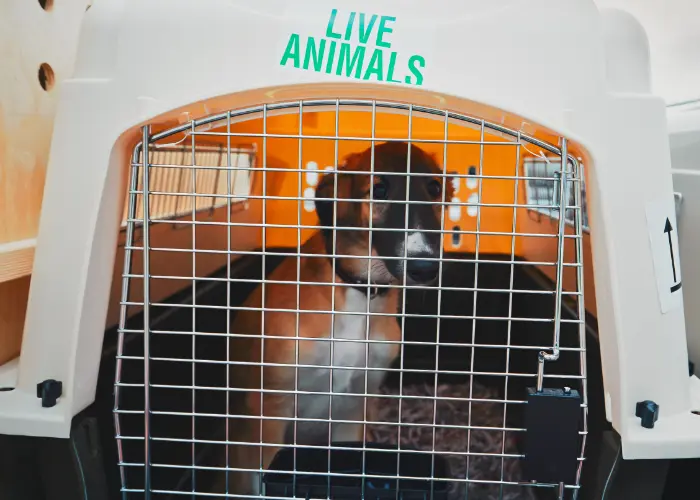
High-profile pet travel incidents changed airline policies. It may seem unfair to keep owners from flying with their pet dogs, but dogs aren’t bags. When they are abused or misplaced, the consequences are much greater. For example, in 2018, a passenger was told to put his crated bulldog into an overhead bin during a flight, and the dog suffocated. In another case, a dog was flown to Japan instead of Kansas. Not surprisingly, the public was appalled to learn how easy it is to lose your beloved pet during an air journey, especially when the people involved have little or no training in managing and caring for pets.
COVID reduced pet shipping options. It was easier to fly your pet before COVID, but the international emergency made it much tougher. With fewer employees on site and fewer planes in the air, transportation became more complex and more expensive. Like many COVID-era restrictions, many of the new rules stuck.

About the Author: Lisa Jo Rudy, M.Div. has been writing on developmental disabilities and mental health since the early 2000s, when her son was diagnosed with autism. Lisa lives on Cape Cod, where she is the proud "mom" of two beautiful cats.
Related Articles
Flying With a Service Dog – The Ultimate Guide
This article was last updated to reflect the latest updates in the DOT’s rules for air travel. This is a guide to everything you need to know to travel with your service dog or psychiatric service dog. You’ve seen a dog in the airport and you’ve always wondered, “how they can fly with their dog?”. […]

Read More

Can You Still Fly with a Miniature Horse on an Airplane
The term “service animal” can cause uncertainty among anyone not familiar with its legal definition. This can result in conflict when it comes to expectations and accommodations in public or with airline travel. As currently stipulated by the Americans with Disabilities Act (ADA), a service animal is defined as a dog specifically trained to perform […]
Read More
How to Fly with a Service Dog on United Airlines
United Airlines offers customers the most comprehensive network of worldwide routes. They also include one-stop or no-stop flights to and from anywhere in the United States. With hubs inside the four largest U.S. cities, it’s no wonder that United Airlines leads the airline industry. If you’re planning on booking a flight, United Airlines is probably […]
Read More