


Service Dog Requirements


If you want to make your dog a Service Dog, your first step is to educate yourself on Service Dog Requirements. The ADA defines a Service Animal as a dog individually trained to perform tasks or do work for the benefit of a person with a disability. A disability can be a physical impairment, but the ADA also includes mental illnesses that substantially limit one or more major life activities, such as depression, severe anxiety, or PTSD.
Service Dog Eligibility
A person is eligible for a service dog if they have a physical, emotional, or mental health disability. Having a dog trained to become a service animal is an option for any individual who has a disability as defined by the Americans with Disabilities Act.
It is not common knowledge that emotional and mental health disabilities would qualify a person for a service dog.
Service Dog Behavior
A service dog must be under its handler’s control at all times. A service dog may bark if provoked but is generally expected to remain calm and cannot cause harm to others.
Service Dog Training
A service dog must be trained to take a specific action when needed to assist the person with a disability. The task(s) performed by the dog must be directly related to the person’s disability. The ADA does not require professional training; people with disabilities have a right to train their service dog themselves.
Service Dog Verification
If it is not obvious what service the dog provides, the handler must be willing to answer two questions about their service dog:
1. Is the dog a service animal required because of a disability?
2. What work or task has the dog been trained to perform?
Staff are not allowed to request any documentation for the dog, require that the dog demonstrate its task, or inquire about the nature of the person’s disability.
Service Dog Identification
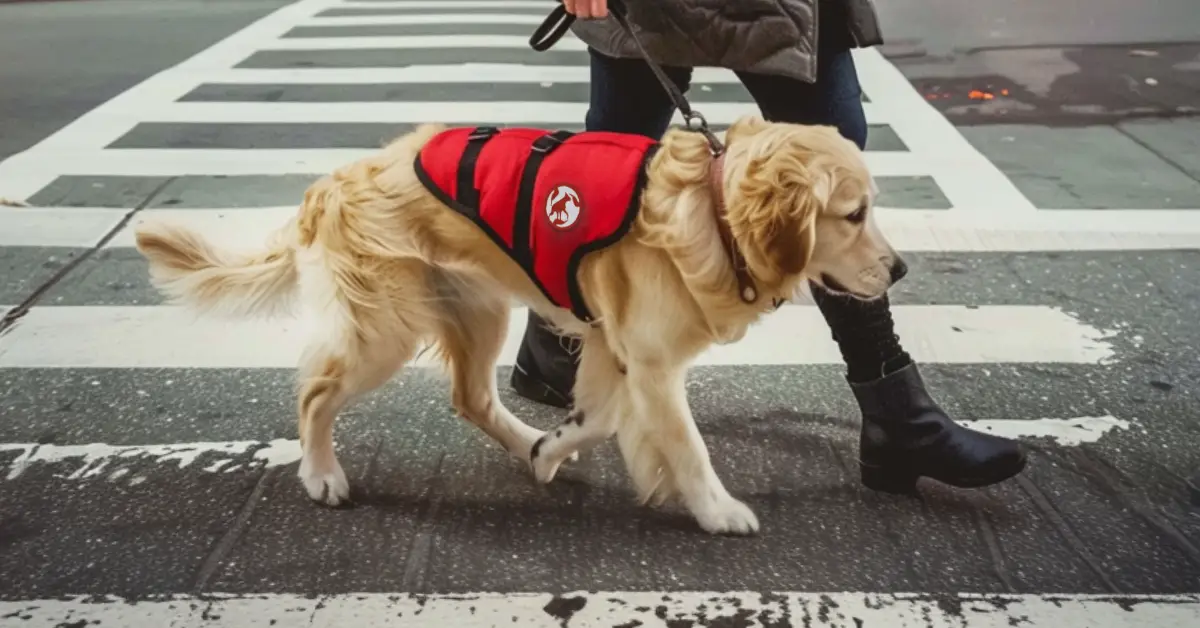
Optionally, it can help if your registered service dog is clearly identified with accessories like ID cards, vests, tags, and certificates. Service Dog registration and identification is not required and do not confer rights.
Make my Dog my Service Dog
Service Dogs serve an important function for those in our community who need special care. If you believe you would benefit from having a Service Dog, education is the first step. It’s crucial for both Service Dog handlers and the general public to be aware of what Service Dog requirements are. Work through these four requirements to see if you can make your dog your service dog:
- Determine if you have an eligible disability
- Train your Service Dog
- Pass a Public Access Test
- Consider Service Dog Certification and Registration
Step 1: Determine if you have an eligible disability
Under the ADA, you must have a qualifying condition to have a Service Dog. Such conditions can take many forms (physical, mental, etc.). Physical disabilities include conditions like visual impairment, limited mobility, and hearing loss. The physical or mental impairment must substantially limit a major life activity, such as the ability to work, move about, socialize, or sleep.
Some common conditions that qualify for Psychiatric Service Dogs are anxiety, depression, and PTSD, but this list is not a complete list. For psychiatric disabilities, a common first step is to be evaluated by a Licensed Mental Healthcare Practitioner (LMHP) who can write a letter confirming your eligibility. These PSD letters are typically:
- written on the licensed healthcare professional’s letterhead;
- dated and signed by the professional;
- contain the professional’s contact information, license number, license date, and state of licensure; and
- contain the professional’s opinion on whether you have a mental or emotional disability that can qualify for a psychiatric service dog.
Step 2: Training your service dog
To be considered a Service Dog, a dog must be individually trained to perform a job or task that mitigates your disability. Be aware that there is no official organization that sets training standards in the U.S. You are not required to work with a trainer – the ADA allows service dog handlers to train their dogs on their own.
While there’s no minimum training requirement in the U.S., some private standards suggest approximately 120 hours over six months. Some sources recommend that at least 30 hours (about ¼ of the time) be spent in public to help train the dog for moments of distraction and when surprises come their way. While not required, it can be helpful for Service Dogs to wear relevant accessories so that people in public can adjust their behavior accordingly.
The most important thing for you to teach your Service Dog is tasking or learning the specific skill it will be performing to assist with your disability. There are countless tasks Service Dogs are called on to perform, including guiding the visually impaired, pulling a wheelchair, sensing the onset of an impending medical emergency, giving tactile stimulation during a panic attack, reminding the handler to take their medication, scouting a room for someone with PTSD, or perform deep pressure therapy in private and public areas.
Step 3: Pass a public access test
In addition to training your dog to perform tasks that assist with your disability, it is important for a service dog to be able to comport itself appropriately in public by passing a public access test.
Public Access Criteria
Your dog must:
- Exhibit no aggressive behavior towards people and other animals.
- Refrain from sniffing behaviors unless released to do so.
- Refrain from soliciting food or affection while on duty.
- Exhibit no over-excitement or hyperactivity in public.
- Be able to tolerate novel sights and sounds in various public settings.
- Refrain from unruly behavior or excessive barking.
- Refrain from relieving itself in public without being given a specific command.
Once your dog is properly trained, your next step is to decide how you prefer to identify your service dog.
Step 4: Service dog certification and registration
Service dog registration and obtaining certification with an ID card sends an immediate signal to staff and the public that your dog is a trained working animal. Accessories like custom ID cards and vests help staff immediately recognize your dog’s role, leading to more positive encounters and fewer people asking about why your service dog is in a no-pets area or in a restaurant.
While you’re not required to carry these items for public access, service dog handlers know that the reality is many establishments still demand to see some form of identification or proof. Having service dog accessories on hand can help you avoid difficult conversations and save the energy of repeatedly explaining ADA service dog regulations.
If you don’t use service dog accessories you’re still fully protected under the ADA. If questioned, staff may only ask two questions when your disability isn’t apparent:
- Whether the dog is a service animal required because of a disability, and
- What specific work or task the dog has been trained to perform.
Unable to Train Your Dog as a Service Dog?
You may be interested in an Emotional Support Animal instead. ESAs do not require specific training, have access to no-pet apartments, and are exempt from breed or weight restrictions. Click here to learn more about ESAs.
In short, ESAs are protected under Federal Housing Regulations (but not the ADA), meaning that you cannot be charged any pet rent, deposits, or fees, nor can you or your ESA be denied housing on the grounds of living with a pet, with very few exceptions.
To qualify for an ESA, you must have a licensed mental health practitioner (including, but not limited to, psychologists, therapists, social workers, GPs/PCPs, etc.) write a letter affirming that you have a qualifying condition (including, but not limited to, depression, anxiety, PTSD, etc.) that is helped by an emotional support animal. Additionally, unlike Service Animals, ESAs do not necessarily have to be dogs; cats, rabbits, and birds are other common choices.
¿Quieres leer este artículo en español?
Puede encontrar una versión traducida al español de los requisitos para perros de servicio aquí.
Want to read this article in Spanish?
You can find a Spanish translated version of Service Dog Requirements here.
About the Author: The writing team at Service Dog Certifications is made up of folks who really know their stuff when it comes to disability laws and assistance animals. Many of our writers and editors have service dogs themselves and share insights from their own experiences. All of us have a passion for disability rights and animals.
Related Articles
Emotional Support Animal Laws
If you live in any state in the U.S. the Fair Housing Act is a federal law (meaning it applies across the country) that guards your rights as the owner of an emotional support animal. Your state might even have its own laws for extra protection. This guide will explain current laws and how they […]

Read More

What to Do if Your Landlord Does Not Accept Your Emotional Support Animal
If your landlord has said no to your emotional support animal, there’s no need to panic; HUD’s rules are on your side. In this article we’ll let you know what you need to do and provide templates for you to smooth communications with your landlord. In this article: Keep in mind that most but not […]
Read More
Service Animal Laws
This article was last updated on August 27th, 2025 If you’re in a business, airport, or residential building with your service dog and need to know the law you can cite that protects you, this guide is for you. We’ll cover each of the major service dog laws in the United States that, together, give […]
Read More